
These Christmas sugar cookies are the ones that make the whole cookie tray look like it came from a bakery — crisp-edged trees, stars, and snowflakes with smooth royal icing and a sprinkle of red and green, soft in the middle and buttery all the way through. The difference between a sugar cookie that holds its shape and one that bakes into a blob is a dough built for cutting: no baking soda, a full hour of chilling, and a gentle hand with the flour. This recipe gets all three right, and the payoff is a cookie that tastes as good as it looks — tender, vanilla-sweet, with the faintest hint of almond in the background.
About 25 minutes of hands-on work, an hour in the fridge, and ten minutes in the oven is the whole bake; the decorating is the fun part, and even a first-time piper can flood a star that looks store-bought. Make them for the cookie exchange, the kids’ decorating afternoon, or the gift tin on the neighbor’s porch: these Christmas sugar cookies are the December classic you will reach for every single year.
Why This Christmas Sugar Cookies Recipe Works
- No baking soda means no spreading. Baking soda is the number-one reason cut-out cookies lose their shape. This dough uses only a little baking powder, so trees stay trees and stars stay stars.
- A full hour of chilling locks the shape in. Cold dough going into a hot oven sets before it can spread — the second half of the no-spread secret, and the reason the edges stay sharp.
- Soft in the middle, lightly crisp at the edges. The cookies bake just until the edges set while the centers stay pale, so they stay tender for days instead of turning crunchy.
- Royal icing that actually floods. A simple meringue-powder icing at 15-second consistency outlines and floods with the same bowl — no fancy tips, no piping experience needed.
- One dough, endless decorating. The same batch makes trees, stars, snowflakes, stockings, and candy canes, so the whole family can decorate their own and no two cookies look alike.
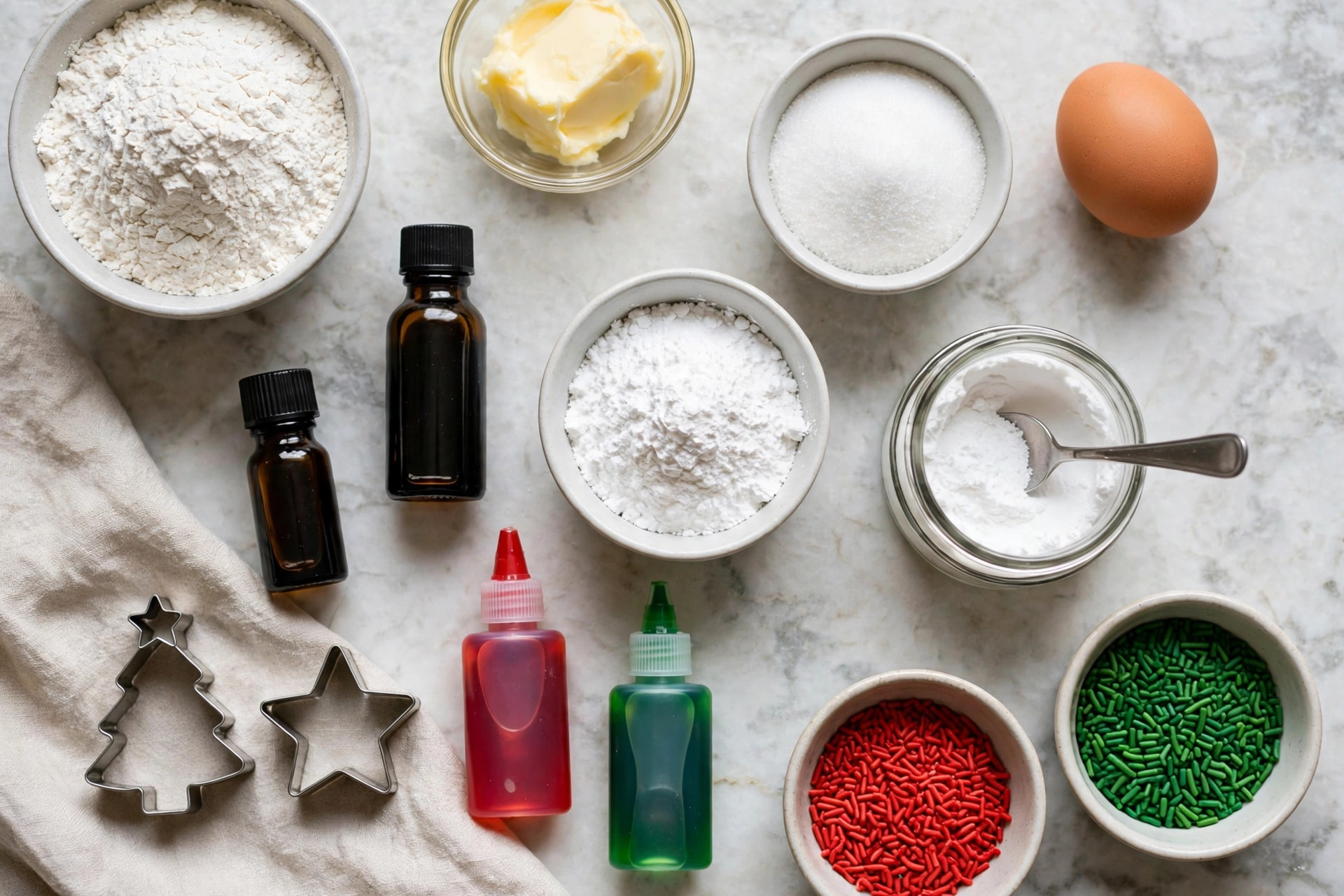
Ingredients for Christmas Sugar Cookies
- 3 cups (375 g) all-purpose flour
- 1/2 teaspoon baking powder
- 1/2 teaspoon salt
- 1 cup (226 g) unsalted butter, softened
- 1 cup (200 g) granulated sugar
- 1 large egg, at room temperature
- 2 teaspoons pure vanilla extract
- 1/2 teaspoon almond extract
- 3 cups (360 g) powdered sugar, sifted, for the royal icing
- 2 tablespoons meringue powder
- 5 to 6 tablespoons warm water
- 1/2 teaspoon clear vanilla extract
- Gel food coloring, red and green
- Christmas sprinkles, for decorating
How to Make Christmas Sugar Cookies
- Whisk the dry ingredients: in a medium bowl, whisk together the flour, baking powder, and salt until evenly combined. Set aside.
- Cream the butter and sugar: in a large bowl, beat the softened butter with the granulated sugar on medium speed until pale and fluffy, about 3 minutes. Scrape down the sides of the bowl.
- Add the egg and extracts: beat in the egg, vanilla extract, and almond extract until smooth and fully combined, about 1 minute.
- Mix in the dry ingredients: add the flour mixture in two additions, mixing on low speed just until a soft dough forms and no dry streaks remain. Do not overmix, or the cookies turn tough.
- Chill the dough: divide the dough in half, flatten each half into a disk, and wrap tightly in plastic wrap. Refrigerate for at least 1 hour, or up to 2 days. Cold dough is the secret to cookies that keep their shape.
- Roll and cut: preheat the oven to 350°F (175°C) and line two baking sheets with parchment paper. Roll one disk of dough between two sheets of parchment to 1/4 inch thick. Cut into Christmas shapes — trees, stars, snowflakes, stockings — and place them 1 inch apart on the sheets. Gather and re-roll the scraps once; chill the scraps again if they get soft.
- Bake: bake for 9 to 11 minutes, until the edges are set and just barely turning golden. The centers should still look pale — that is what keeps them soft.
- Cool completely: let the cookies rest on the pan for 5 minutes, then move them to a wire rack to cool fully before decorating, about 30 minutes. Warm cookies melt royal icing.
Making the Royal Icing
- Make the royal icing: in a clean bowl, beat the powdered sugar, meringue powder, warm water, and clear vanilla extract on low speed until smooth, about 2 minutes. The icing should ribbon off the spoon and smooth back into itself in about 15 seconds — add water a teaspoon at a time to thin it, or a spoonful of powdered sugar to thicken it. Divide into bowls and tint with gel food coloring.
- Decorate and let set: spoon the icing into piping bags or zip-top bags with a tiny corner snipped off. Outline each cookie, then flood the center and use a toothpick to guide the icing to the edges. Add sprinkles while the icing is still wet. Let the cookies dry uncovered for at least 8 hours, or overnight, until the icing is completely hard.

Pro Tips for Perfect Christmas Sugar Cookies
- No baking soda, ever. Baking soda is the number-one reason cut-out cookies spread and lose their shape — this dough uses only a little baking powder, so trees stay trees and stars stay stars.
- Chill the dough for the full hour, and chill the cut shapes again if your kitchen is warm. Cold dough going into a hot oven is the other half of the no-spread secret.
- Roll the dough between two sheets of parchment paper instead of on a floured counter. Extra flour dries the dough out and makes the cookies tough; parchment keeps them tender and easy to lift.
- Aim for 15-second royal icing. Lift the spoon and count: the ribbon of icing should disappear back into the bowl in about 15 seconds. Thicker icing holds outlines; thinner icing floods smoothly — this middle ground does both.
- Let the icing dry overnight before stacking or packing the cookies. Royal icing looks dry after an hour, but it needs a full 8 hours to harden all the way through — stacking too soon smudges the design.

Variations
- Chocolate sugar cookies: Replace 1/2 cup of the flour with 1/2 cup of unsweetened cocoa powder for dark chocolate cut-outs that look stunning with white royal icing.
- Lemon sugar cookies: Swap the almond extract for 1 tablespoon of lemon zest and 1 teaspoon of lemon extract — bright, fresh, and lovely with pale yellow icing.
- Sprinkle cookies (no icing needed): Skip the royal icing entirely and press the cut shapes into red and green sanding sugar before baking — the fastest decorated cookie on the tray.
- Cream cheese sugar cookies: Replace 4 tablespoons of the butter with 4 ounces of softened cream cheese for an extra-tender, slightly tangy cookie that stays soft even longer.
- Gluten-free: Use a 1-to-1 gluten-free baking flour blend in place of the all-purpose flour — the dough is a little softer, so chill it for 90 minutes before rolling.
Storage
Store the decorated cookies in an airtight container at room temperature for up to 1 week, with parchment paper between the layers so the icing does not stick or smudge. Undecorated cookies keep just as long, and the dough freezes beautifully — wrap the disks tightly and freeze for up to 3 months, then thaw overnight in the fridge before rolling. Baked, undecorated cookies also freeze well for up to 2 months; thaw at room temperature and decorate as usual. Never refrigerate decorated cookies: the humidity in the fridge makes royal icing weep and bleed.
Frequently Asked Questions
Can I make Christmas sugar cookies ahead of time?
Yes. The dough keeps in the fridge for up to 2 days or in the freezer for 3 months, and the decorated cookies stay fresh for a week at room temperature — so you can bake on the weekend and decorate during the week.
Why did my cookies spread and lose their shape?
Almost always one of two things: the dough was not cold enough, or the recipe used baking soda. Chill the dough for the full hour, chill the cut shapes if your kitchen is warm, and use a recipe with no baking soda, like this one.
Do I have to use royal icing?
No. A simple buttercream frosting tastes wonderful on these cookies, but it never hardens, so the cookies cannot be stacked or packed. Royal icing is the choice when you want to gift or ship them.
How long does royal icing take to dry?
At least 8 hours uncovered at room temperature, and overnight is safest. The surface looks dry after about an hour, but the icing underneath is still soft — stacking too soon smudges the design.
How many cookies does this recipe make?
About 36 cookies using standard 3-inch cutters. Smaller cutters make more, larger cutters make fewer — the recipe scales perfectly if you need a double batch for a cookie exchange.
Christmas Sugar Cookies
Ingredients
- 3 cups all-purpose flour (375 g)
- 1/2 teaspoon baking powder
- 1/2 teaspoon salt
- 1 cup unsalted butter, softened (226 g)
- 1 cup granulated sugar (200 g)
- 1 large egg at room temperature
- 2 teaspoons pure vanilla extract
- 1/2 teaspoon almond extract
- 3 cups powdered sugar, sifted, for the royal icing (360 g)
- 2 tablespoons meringue powder
- 5 to 6 tablespoons warm water
- 1/2 teaspoon clear vanilla extract
- Gel food coloring red and green
- Christmas sprinkles for decorating
Instructions
- Whisk the dry ingredients: in a medium bowl, whisk together the flour, baking powder, and salt until evenly combined. Set aside.
- Cream the butter and sugar: in a large bowl, beat the softened butter with the granulated sugar on medium speed until pale and fluffy, about 3 minutes. Scrape down the sides of the bowl.
- Add the egg and extracts: beat in the egg, vanilla extract, and almond extract until smooth and fully combined, about 1 minute.
- Mix in the dry ingredients: add the flour mixture in two additions, mixing on low speed just until a soft dough forms and no dry streaks remain. Do not overmix, or the cookies turn tough.
- Chill the dough: divide the dough in half, flatten each half into a disk, and wrap tightly in plastic wrap. Refrigerate for at least 1 hour, or up to 2 days. Cold dough is the secret to cookies that keep their shape.
- Roll and cut: preheat the oven to 350°F (175°C) and line two baking sheets with parchment paper. Roll one disk of dough between two sheets of parchment to 1/4 inch thick. Cut into Christmas shapes — trees, stars, snowflakes, stockings — and place them 1 inch apart on the sheets. Gather and re-roll the scraps once; chill the scraps again if they get soft.
- Bake: bake for 9 to 11 minutes, until the edges are set and just barely turning golden. The centers should still look pale — that is what keeps them soft.
- Cool completely: let the cookies rest on the pan for 5 minutes, then move them to a wire rack to cool fully before decorating, about 30 minutes. Warm cookies melt royal icing.
- Make the royal icing: in a clean bowl, beat the powdered sugar, meringue powder, warm water, and clear vanilla extract on low speed until smooth, about 2 minutes. The icing should ribbon off the spoon and smooth back into itself in about 15 seconds — add water a teaspoon at a time to thin it, or a spoonful of powdered sugar to thicken it. Divide into bowls and tint with gel food coloring.
- Decorate and let set: spoon the icing into piping bags or zip-top bags with a tiny corner snipped off. Outline each cookie, then flood the center and use a toothpick to guide the icing to the edges. Add sprinkles while the icing is still wet. Let the cookies dry uncovered for at least 8 hours, or overnight, until the icing is completely hard.
Notes
- No baking soda, ever. Baking soda is the number-one reason cut-out cookies spread and lose their shape — this dough uses only a little baking powder, so trees stay trees and stars stay stars.
- Chill the dough for the full hour, and chill the cut shapes again if your kitchen is warm. Cold dough going into a hot oven is the other half of the no-spread secret.
- Roll the dough between two sheets of parchment paper instead of on a floured counter. Extra flour dries the dough out and makes the cookies tough; parchment keeps them tender and easy to lift.
- Aim for 15-second royal icing. Lift the spoon and count: the ribbon of icing should disappear back into the bowl in about 15 seconds. Thicker icing holds outlines; thinner icing floods smoothly — this middle ground does both.
- Let the icing dry overnight before stacking or packing the cookies. Royal icing looks dry after an hour, but it needs a full 8 hours to harden all the way through — stacking too soon smudges the design.